
The conversation that shows everything
Between my sets at the gym I got talking with a young woman, the way you do.
"You work with AI? I know Fable 5."
I thought: ok cool, she knows her stuff.
"What do you use Fable 5 for?" I asked.
"I'm a lawyer, I use it to analyse my texts."
Ok great, I thought, she's driving a Ferrari for a trip any car could make.
"I tried ChatGPT too, but it wasn't as good. Personal data I don't put in there, of course."
Sure, I thought, she's a lawyer. Data protection is her home turf.
"Exactly right. Most people forget that. Take a look at NotebookLM. It works directly with your own documents."
She just looked at me, confused.
Ok, I thought, maybe I'm going too deep here.
Because slowly I realised: she'd said "Fable 5" as if she knew what it was. She didn't.
Then she pulled out her phone.
"So which subscription should I buy? What am I even using here? Here's Fable 5, here's ChatGPT."
"Aren't you using Fable 5 through Anthropic?"
"Anthropic? What's that?"
"Show me. Are you even on Anthropic's site?"
She showed me her phone: third-party apps everywhere. She'd never heard of the original.
"Ok, stop. Go straight to Anthropic."
I showed her, quickly explained the models, and then she bought Pro, calmly.
The data protection she had down cold, that's what she's a lawyer for. But what she was actually using, from whom, and what the original is, that she didn't know. Everyone has AI access today. Almost no one has a clear view.
So this doesn't happen to you, here's the map in two minutes:
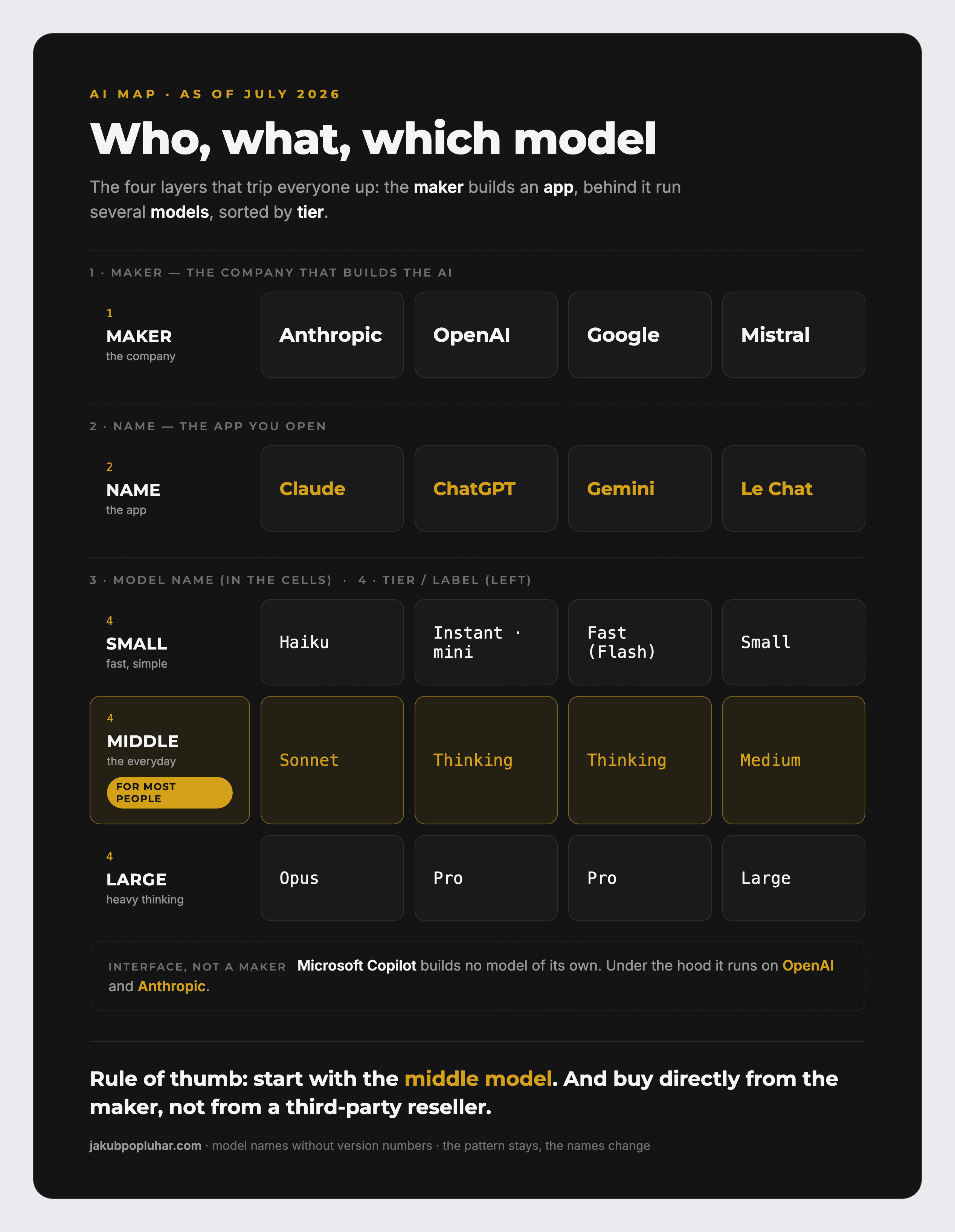
1. There are only a handful of makers
The companies that actually build the AI you can count on one hand:
- Anthropic (models: Claude, Fable)
- OpenAI (models: GPT, known through ChatGPT)
- Google (models: Gemini)
- Mistral (from France)
Those are the makers. The brand. When you buy a subscription, you want to be directly with one of them, not with a third-party reseller that just marks up their access.
And careful, here's where it gets tricky: not everything that looks like AI is a maker. Microsoft Copilot, for example, builds no model of its own. Copilot is an interface from Microsoft that runs someone else's models under the hood, currently from OpenAI and Anthropic [3] [4]. You talk to Copilot, but what answers you is a model from OpenAI or Anthropic. Good to know when you want to understand what you're actually paying for.
2. Every maker has several models
A maker isn't one model, it's a whole model line-up, like a car brand. Roughly, everyone has three tiers: a small, fast model, a middle one for everyday use, and a large one for the heavy stuff.
That's the map, here again in text form:
| Tier | Anthropic | OpenAI | Google Gemini | Mistral |
|---|---|---|---|---|
| Small, fast | Haiku | Instant, mini | Fast (Flash) | Small |
| Middle, everyday | Sonnet | Thinking | Thinking | Medium |
| Large, powerful | Opus | Pro | Pro | Large |
As of July 2026. The model names change fast, the pattern stays. [1] [2]
You'll notice: OpenAI and Google name their tiers almost the same, "Thinking" and "Pro". That's no accident. They're all basically building the same offer: fast and cheap at the bottom, powerful and expensive at the top.
3. Every model is built for something different
- Small: fast, simple tasks. Short answers, summaries, quick questions.
- Middle: the everyday. Writing texts, analysing, most normal work.
- Large: the heavy thinking tasks. Complex analysis, tricky reasoning, large documents.
4. The rule of thumb: for most people the middle model is enough
Most people reflexively reach for the biggest, because "bigger = better". Usually wrong. The large model is slower and more expensive, and for a big share of daily work you won't notice the difference at all.
The middle model is the sweet spot: Sonnet, Thinking, Medium, depending on the maker. Fast enough, powerful enough, cheap enough. Start there. You reach for the large one only when the middle one clearly stops being enough.
What to take away
Three questions, and you're miles ahead of the lawyer in the story:
- Who is the maker? (Anthropic, OpenAI, Google, Mistral. Or an interface like Copilot that uses their models.)
- Which model? (Small, middle, large.)
- Is the middle model enough? (Usually yes.)
And the most important reflex: buy at the source, directly from the maker.
In the next article we go one level deeper. Because the models can do more than their name lets on. The large model, for example, can be set to "think more", and a powerful model becomes a genuinely powerful one. More on that soon.
Sources
As of July 2026. Model line-ups change constantly, when in doubt check directly with the maker.
[1] OpenAI, "Model Release Notes", OpenAI Help Center: https://help.openai.com/en/articles/9624314-model-release-notes
[2] "ChatGPT Models Explained: Complete Comparison Guide (2026)", ai-toolbox.co: https://www.ai-toolbox.co/chatgpt-models/chatgpt-models-explained-complete-comparison-2026
[3] Microsoft, "Anthropic joins the multi-model lineup in Microsoft Copilot Studio", Microsoft Copilot Blog: https://www.microsoft.com/en-us/microsoft-copilot/blog/copilot-studio/anthropic-joins-the-multi-model-lineup-in-microsoft-copilot-studio/
[4] "Microsoft's Copilot makes Anthropic's Claude and OpenAI's GPT team up", The New Stack: https://thenewstack.io/microsofts-copilot-llm-team/