
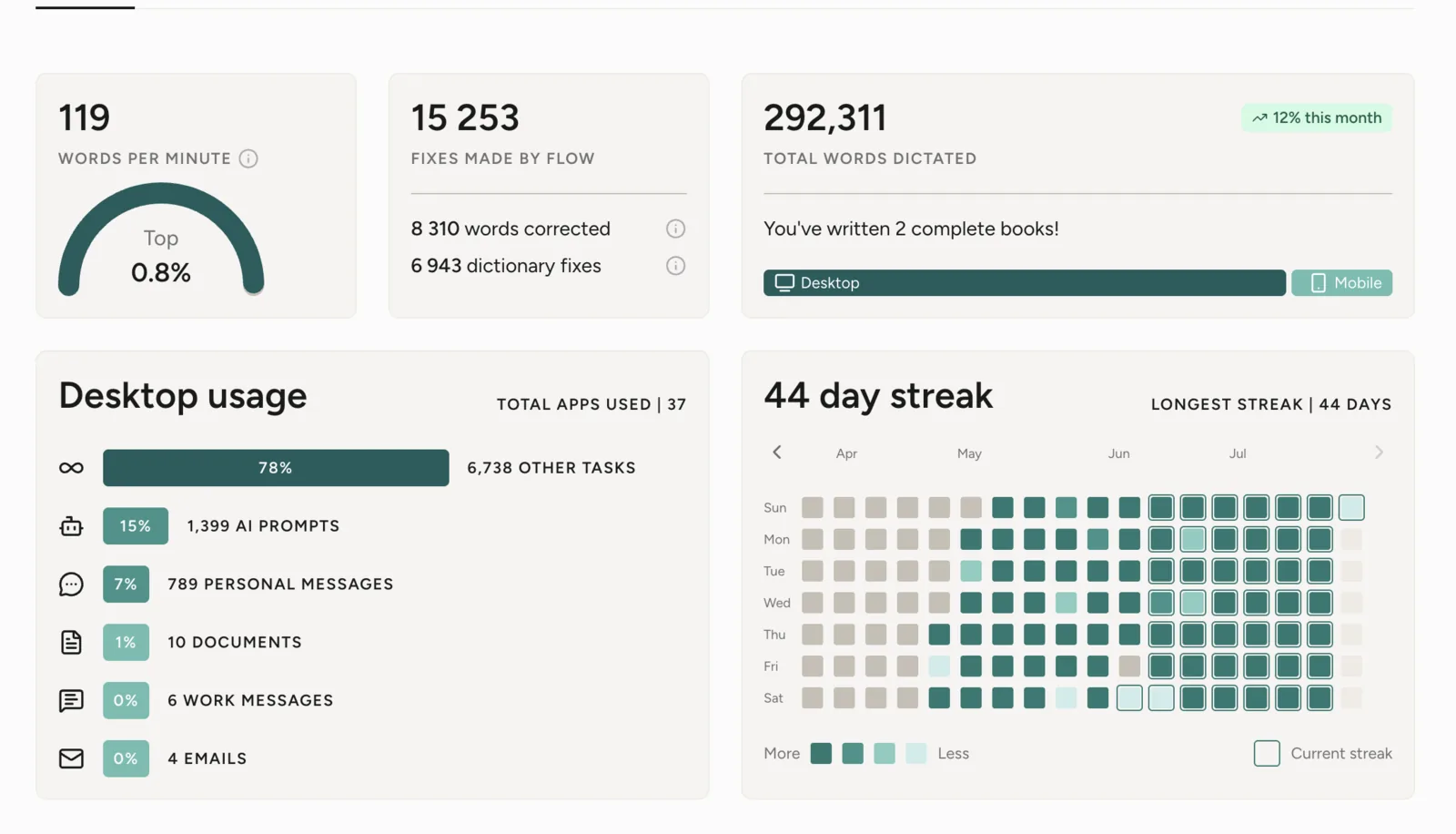
My dictation tool knows two categories: "AI Prompts" and "Other Tasks". Four out of five words I speak fall into neither correctly.
I use a dictation tool called Wispr Flow, which logs every word and attributes it to the app it went into. According to the dashboard, only 15 percent of my desktop usage counted as "AI Prompts".
When I read that, I thought: "Wait a minute, that can't be right."
The rest, 78 percent, filed under "Other Tasks". At first glance that looks like a missing category: my terminal simply isn't recognized. A terminal is the text window you use to give a computer direct commands instead of clicking through a mouse and menus. For me, that's where my AI agent lives and works.
I said to Zoya, my AI assistant:
"Write an email to Wispr Flow, I want to know how much of that is actually happening in the terminal."
Her answer came back different from what I expected:
"Sure, I can do that, but I could also just look in the folder myself, if you want, and tell you." (Zoya)
I was a little surprised, but okay: "Do that."
And that's how the numbers came in, share of terminal across all dictated words:
- Since May (all-time): 79.5%
- Last 14 days: 81.6%
- Factor 9 over the second-placed app (a research tool, roughly 18,600 words since May vs. the terminal's 167,000+)
More interesting than the snapshot is the monthly trend:
| Month | Share |
|---|---|
| May 2026 | 73.9% |
| June 2026 | 82.6% |
| July 2026 (so far) | 81.9% |
But the longer I sit with the number, the clearer it gets: it's not just a missing category. It's the wrong category. Wispr Flow apparently understands "AI Prompt" as only the short question to a chat window, one-off, closed the moment it's answered. What I talk into my terminal all day is also a prompt, just a different kind of one: I rarely ask questions. I give direction.
The difference is a role, not a tool
When I dictate, I don't say "what's the capital of X" or "rewrite this sentence for me". I say what the outcome should be, and hand off the path to get there. The agent reads files, tries things, corrects itself, comes back with a follow-up question or a proposal I accept or reject. That's not a conversation with a chatbot. That's an instruction to someone who takes on the execution independently and brings the result back to me.
That's the role of the orchestrator. I hold the vision, the goal, the definition of "done". The agent is the hand that executes, with its own room for proposals, but without the final call on what counts at the end. This role exists in any collaboration where one person knows where things need to go and another does the work. What's new is only that the executing side is now an AI, and that I orchestrate it by voice instead of by text.
Sports analogy: the video analyst, not the player
Closer to a video analyst in football than to a player. A player executes a shouted instruction. An analyst reviews the whole match and comes back with a condensed assessment. That's exactly what Zoya did above: she didn't run a single command, she searched the entire database and brought me back a number I'd never have found otherwise. I could have looked it up myself, the whole time. What I delegated was only the time it would have cost me.
Wispr Flow, by the way, calls my dictation profile "Directive Manager" on its own, derived automatically from my own dictations.
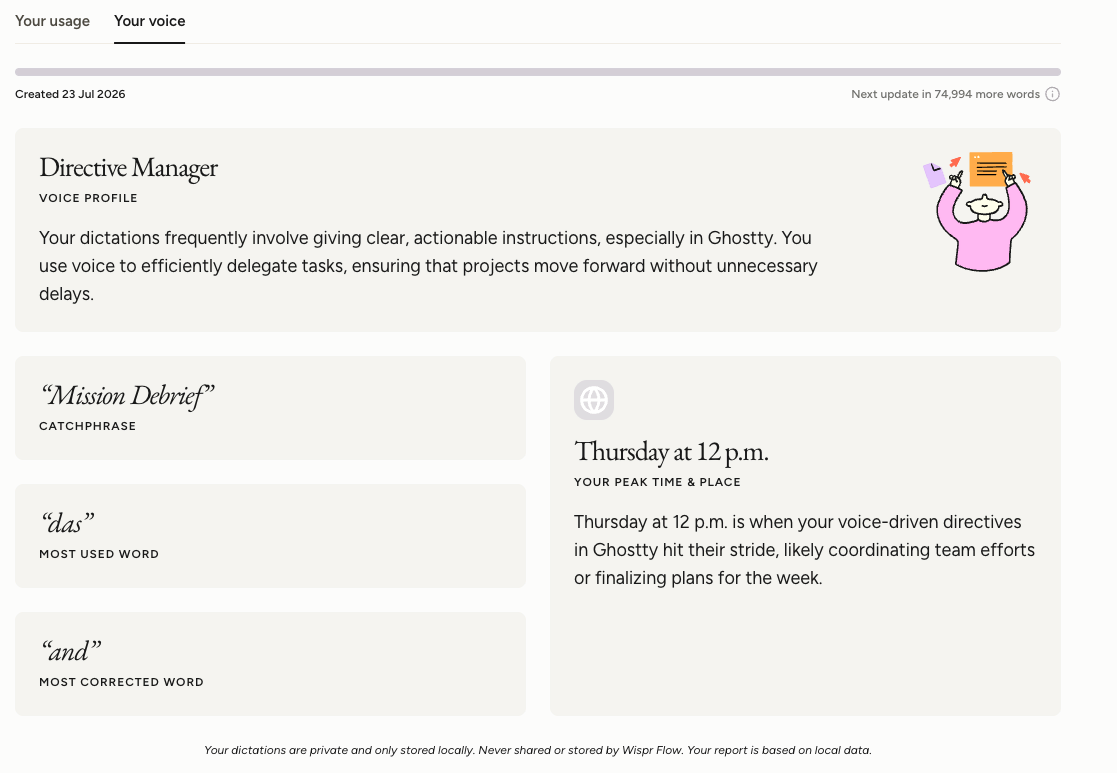
Fitting, by coincidence. I dictate. In the end, for me, that means: I delegate.
Why the number is still the right way in
The number above is the evidence, not the story itself. It shows how much my everyday language has shifted from "I ask something" to "I set a direction", without me ever training for it on purpose.
That's why the error in my dashboard is more interesting than a technical detail. It shows that the tools measuring us still come from an era when AI was a window you asked something. For the role most of us now actually work in with AI, the orchestrator, these tools still have no category. The speaking itself has already moved further than the statistic meant to measure it.
Sources
The Wispr Flow link above is a referral link (I get a free month for it). The numbers in this article are my real, actual usage data, independent of that.