
For weeks I've been planning a big business trip to Southeast Asia. My parents are joining me for part of it, and for two days now we've been working out how all of us will get online on the road. My father is nervous, my mother is searching on her own in parallel and sending me a new question every few minutes. On the table, water and coffee. On the screen, research agents heading out and coming back.
Sunday, 14:36, the next question: how do we get online cheaply in Thailand, the Philippines and Vietnam without my Austrian number going silent for clients? I dictate in Slovak: "Pošli viacero agentov do vojny." Send several agents to war.
Three agents move out, followed by a second, deeper round. After a good hour the result is in: a clean table with Airalo, Nomad, Holafly and the tourist SIMs at the airport, recommendation about €89.
I read it and I'm not happy, because every price in it is made for tourists. My reply, translated from Slovak: "These are all just prices for tourists or Western Europeans. Search in the languages of these countries, so in Tagalog, Vietnamese and Thai. Again."
Why does the AI find tourist prices first?
Because it takes the easy way. That's how I summed it up myself afterwards, translated: "The AI likes to take the easier path and reads the English pages first. We have to use the local language."
I had asked in Slovak, the agents had searched in English. English pages about SIM cards in Thailand are written for people who don't live there: travel blogs, eSIM shops, guides for arriving at the airport. They show what foreigners pay. The pages get that right, they write for their audience.
So the first table wasn't wrong. It answered a different question from the one I had asked: what does a tourist pay? I wanted to know what it costs.
What did the search in the local language find?
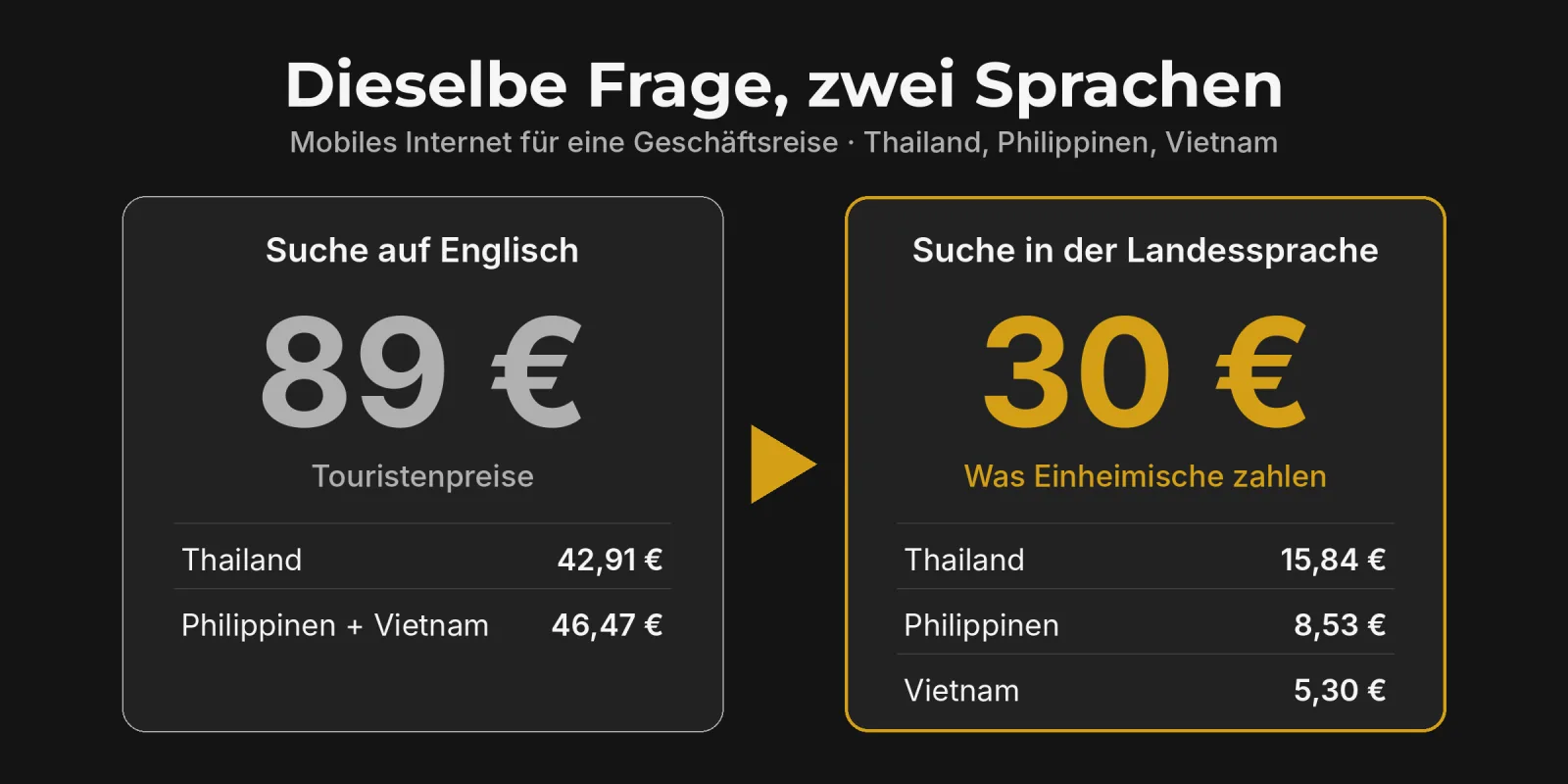
Three new agents head out, one per country, each in that country's language. The Thai agent searches with terms like "ซิมเติมเงิน เน็ตไม่อั้น" (prepaid SIM, unlimited internet) and reads the Thai-language site of the biggest provider, AIS. There it finds a package that turned up on no English travel site: Net Marathon Max, three months, 50 GB a month, 590 baht. That's €15.84. The same provider's tourist SIM costs 1,599 baht for 60 days, so €42.91.
| Country | English round | Local language | Source, local language |
|---|---|---|---|
| Thailand | AIS Tourist, 60 days: 1,599 THB (€42.91) | AIS Net Marathon Max, 3 months: 590 THB (€15.84) | ais.th, Thai-language page |
| Philippines | Globe Traveler: 1,750 PHP (€24.97) | DITO eSIM + Level-Up 499: about 598 PHP (€8.53) | dito.ph |
| Vietnam | Airalo, 15 days: €45.00 | Viettel 5G150T, 30 days: 150,000 VND (€5.30), tourist package close to the local price | vietteldata.vn |
The recommendation for the whole trip fell from about €89 to about €30. Converted at the rate of 20 November, 37.26 baht to the euro.
Behind it sits the same network from the same provider, just a different package: the one locals buy.
Where did the language lever not work?
In fairness: not equally well everywhere.
Philippines. The searches in Tagalog mostly returned English SEO pages, because English is the language of business there. The cheaper price came from the official site of the provider DITO, less from the local language. Here the language lever was small.
Vietnam. The carriers' sites weren't readable for the agent, they loaded blank or blocked it. So the prices come from the Viettel store and from reseller and advice sites, which are weaker sources, and need checking at the counter. On top of that came a finding that sharpens the point: Viettel's tourist package is already almost at the local price. The big mark-up was in the Western travel eSIM for €45.
Thailand. Since 16 May 2026, foreigners can only register SIM cards in person with a passport. Then there's the small print under the prices on the AIS site: "จำหน่ายเฉพาะช่องทางออนไลน์เอไอเอส", sold only through AIS's online channels. So the 590-baht package is only available online, on a page in Thai. The site doesn't exclude foreigners, but whether a tourist can actually buy there, I don't know yet. I'll try it on the ground and report back. Until then, the fallback is the tourist SIM.
The biggest lever was clearly in Thailand.
Which sentence in the prompt makes the difference?
This one, to copy:
Search in the local language of [country], on the sites of local providers, for what locals buy there. For every price, give the source and say whether the page is written for foreigners or for locals. Show me the search terms you used in the local language. Only then compare with the tourist offer.
The search terms are your test. If they're all English words, the agent didn't follow the instruction.
I tested the sentence that afternoon on SIM tariffs. The same idea holds for prices, laws, providers and reviews in another country: what's written for foreigners shows the view from outside.
What did one minute on my own phone show?
The same afternoon brought the counterpart. At 17:46 Revolut reported "eSIMs aren't supported on your device". Two minutes later, a screenshot of the model number showed it: my iPhone is a China model, with two physical SIM slots and no eSIM. Three rounds of eSIM research had rested on an assumption the AI itself had written into the instructions.
The language of the search is a lever. A look at your own device is the first one.
What is research like this worth?
A difference of about €59, for a single question on a Sunday afternoon. My own AI subscription costs more, and one afternoon like this doesn't pay for it on its own.
My father is still on the free version. Maybe after this afternoon he'll think about a paid subscription. We'll see. That'll be a tough sell.
In my AI trainings I show exactly this lever: the local language and the one sentence in the prompt. It needs no new software, just one more line in the instruction.
Anyone in purchasing comparing suppliers in another country, or in sales sizing up prices in a foreign market, gets the pages written for foreigners from the AI first. The research looks complete, the table looks clean, and it answers a visitor's question.
The AI speaks your language. The cheap prices are in another one.
Common questions
What is this article about?
When AI research agents look up prices abroad, they read English pages first, and those are written for foreigners and show foreigners' prices. With the instruction to search in the local language, on local sites, for the packages locals buy, a recommendation for mobile data in Thailand, the Philippines and Vietnam dropped from about €89 to about €30. Thailand made the biggest difference: 590 baht instead of 1,599.
Why do ChatGPT and Claude only find tourist prices abroad?
Because AI research reads English pages first, and English pages about a country like Thailand are mostly written for visitors: travel blogs, eSIM shops, airport guides. They show what foreigners pay. In my test, the English round for mobile data in Thailand, the Philippines and Vietnam came to about €89, the search in the local language to about €30.
How do I get an AI to search in the local language?
By asking for it explicitly: in the local language, on the sites of local providers, for what locals buy. Have it show you the search terms it used. In my case the agent searched in Thai with terms like "ซิมเติมเงิน เน็ตไม่อั้น" and found a 590-baht package on AIS's Thai-language site that appeared on no English travel site.
What does a local prepaid SIM in Thailand cost compared with the tourist SIM?
According to AIS's Thai-language site, Net Marathon Max costs 590 baht for three months with 50 GB a month, about €16. The AIS tourist SIM costs 1,599 baht for 60 days, about €43. Whether a tourist can get the local package in a shop since in-person registration became mandatory on 16 May 2026 is not yet confirmed.
Does the local language help equally in every country?
No. In the Philippines, searches in Tagalog mostly returned English pages, because English is the language of business there. In Vietnam the carriers' sites weren't readable for the agent, and Viettel's tourist package was already almost at the local price. The biggest difference showed up in Thailand.
Is an AI subscription worth it for research like this?
In this case, one question on one afternoon made a difference of about €59, from about €89 to about €30 for mobile data. A monthly subscription won't necessarily pay for itself on that alone. What really mattered was one sentence in the instruction: search in the local language.
Sources
- AIS, Net Marathon Max (Thai-language page): https://www.ais.th/consumers/package/exclusive-plan/sim-netmarathon-max
- AIS, Tourist SIM: https://www.ais.th/en/consumers/package/international/tourist-plan
- DITO, Level-Up: https://dito.ph/prepaid/level-up
- Globe, Traveler SIM: https://www.globe.com.ph/international/traveler-sim
- Viettel tourist packages (advice site, not official): https://www.vietteldata.vn/tin-tuc/viettel-esim-vietnam-tourist-plans-guide
- Tilleke & Gibbins on SIM registration in Thailand since 16 May 2026: https://www.tilleke.com/insights/thailand-tightens-telecom-registration-data-and-ip-address-rules-to-combat-tech-crime
- Exchange rate: 37.26 baht to the euro, as of 20 November 2026